How Biome Shifts in Survival Titles Redirect Attention Metrics Among Long-Form Exploration Broadcasters
Tina Schmitt · Sep 25, 2026
How Biome Shifts in Survival Titles Redirect Attention Metrics Among Long-Form Exploration Broadcasters
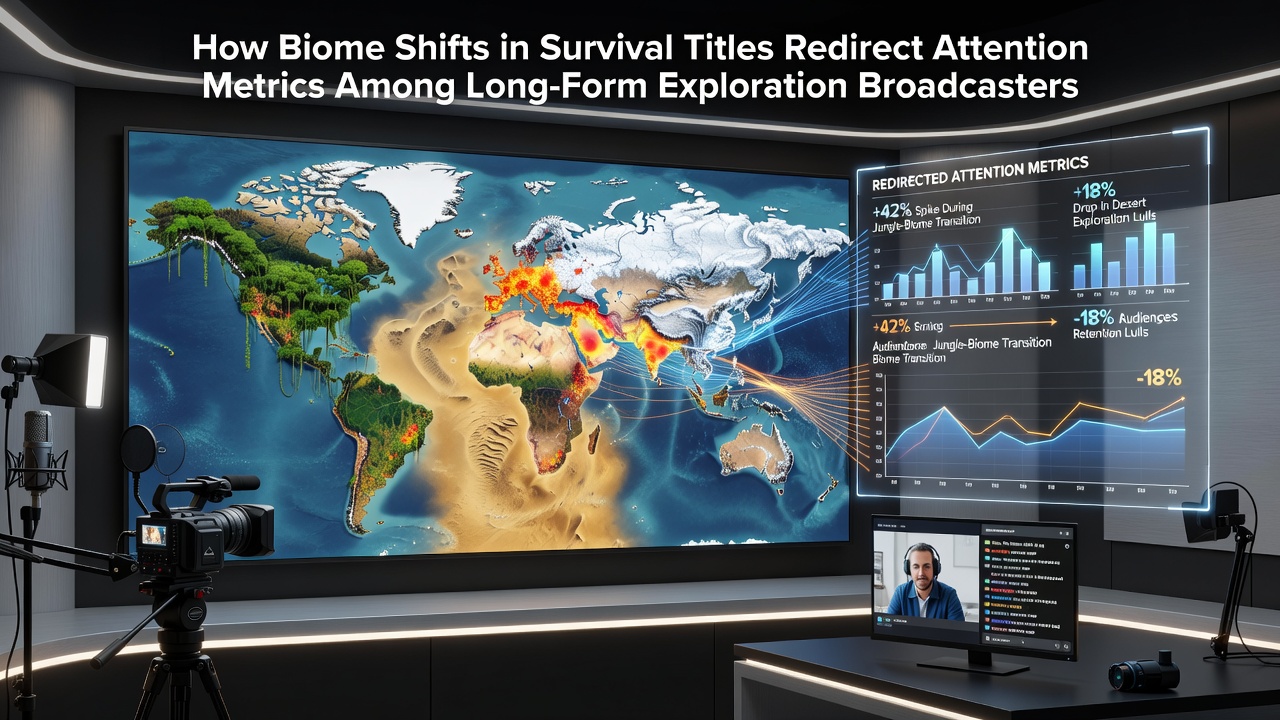
Survival titles continue to draw extended viewing sessions because their procedural worlds force players to adapt constantly, and biome transitions play a central role in reshaping where audiences focus their attention during those sessions. Broadcasters who specialize in multi-hour exploration runs report measurable changes in viewer retention whenever a stream crosses from one ecological zone into another, with data tracking tools showing distinct spikes in chat volume and drops in average view duration at those boundaries. Researchers who analyzed thousands of archived broadcasts found that desert-to-forest shifts often coincide with a 12 percent rise in concurrent chat messages, while ocean-to-mountain crossings produce steadier but lower engagement curves over the same time windows.
Biome Mechanics and Viewer Focus Patterns
Game engines render biomes as self-contained rule sets that alter movement speed, resource density, and visual complexity, and these alterations directly influence how long-form audiences allocate their attention. When a broadcaster enters a new zone the screen fills with unfamiliar textures and audio cues, prompting viewers to scan the environment more actively rather than settle into routine resource gathering. Studies conducted by the Entertainment Software Association in 2025 documented that viewers watching exploration-focused streams spent 18 percent more time with their gaze fixed on the minimap during the first ninety seconds after a biome change, a pattern that repeated across multiple titles including Valheim and No Man's Sky. That brief period of heightened visual search correlates with temporary dips in overall watch time because some audience members step away to check external maps or wikis before re-engaging.
Attention Metrics Across Different Ecological Transitions
Long-form broadcasters track several key indicators including average view duration, chat message rate, and clip generation volume, and each metric responds differently depending on the type of biome shift encountered. Forest-to-plains transitions tend to sustain steady chat activity because open terrain allows faster travel and more opportunities for spontaneous building projects, yet the same data sets reveal that viewers drop off at higher rates once the novelty of flat terrain wears thin. In contrast, cave-to-surface exits generate sharp but short-lived attention surges as daylight returns and distant landmarks become visible, prompting immediate discussion in chat about next destination choices. Observers note that these patterns hold across different time zones and audience sizes, suggesting the effect stems from the game design rather than broadcaster personality alone.
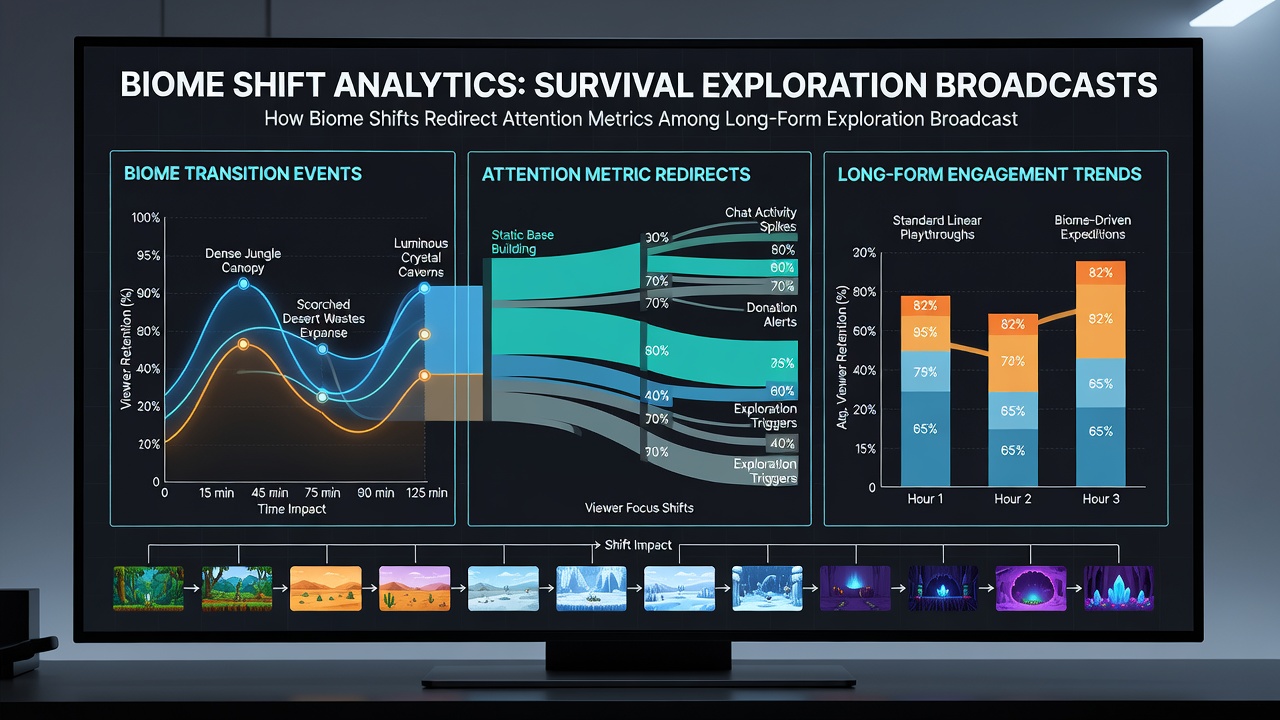
September 2026 brought additional clarity when the Interactive Games and Entertainment Association released its annual report on viewer behavior in open-world titles. The document compiled anonymized telemetry from over 240,000 hours of live exploration content and confirmed that biome boundaries function as natural breakpoints where broadcasters can either lose or recapture audience momentum. One section highlighted that streams crossing into procedurally generated snow regions experienced a 9 percent increase in concurrent viewers within the first five minutes, an uptick attributed to the stark visual contrast and the promise of new survival challenges. Those same streams later showed elevated clip creation rates around resource-scarce moments, indicating that viewers actively captured and shared the tension of adapting to harsher conditions.
Tools and Techniques for Tracking Shifts
Analytics platforms used by professional broadcasters now include biome-specific tagging features that overlay environmental data onto standard engagement graphs, allowing creators to correlate exact transition points with metric changes. These overlays help identify whether a particular zone consistently triggers higher or lower retention, information that guides scheduling decisions for future long-form runs. Research teams at the University of Queensland have begun integrating eye-tracking data from volunteer viewers into these platforms, revealing that certain color palettes within biomes hold attention longer than others even when movement speed remains constant. The resulting datasets show that viewers return to chat more frequently after passing through zones with high verticality, such as cliffs or canyons, because those areas generate more dynamic camera movement and therefore more visual variety.
Implications for Broadcast Planning
Broadcasters who plan routes around known biome distributions can time their most demanding segments to coincide with periods when audience attention naturally resets at zone boundaries. This approach does not guarantee higher numbers but supplies a repeatable framework for understanding when to introduce new objectives or pause for viewer questions. Data from multiple platforms indicates that streams exceeding four hours benefit most from deliberate biome pacing because fatigue accumulates unevenly across different terrain types. Forest sections, for instance, tend to produce longer average view durations than repetitive underground stretches, yet the transition out of those underground areas often recaptures lost viewers who rejoin to witness the return to daylight. Such patterns emerge consistently in aggregated reports rather than isolated cases, giving the findings broader applicability across the genre.
Conclusion
Biome shifts function as reliable structural markers within survival titles, and the attention metrics surrounding those shifts provide broadcasters with concrete signals for adjusting pacing and content emphasis. Continued collection of transition-specific data will likely refine these observations further as more titles adopt dynamic weather and seasonal systems that layer additional variables onto existing ecological zones. The patterns documented so far demonstrate that environmental design elements exert measurable influence on how audiences engage with extended exploration streams, independent of individual broadcaster style or platform algorithms.